
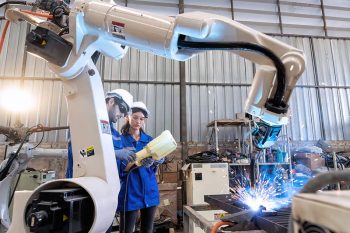
An industrial robot can return to the same point within a few hundredths of a millimetre, thousands of times a shift. That consistency only helps if the parts around the robot are right. If a base plate is out of flat, a fixture has shifted or gripper fingers have worn, the robot will keep repeating its movement perfectly into the wrong position.
This is why CNC machining for automation and robotics matters. Machined base plates, end-of-arm tooling, fixtures, brackets and frames hold every robot, sensor and conveyor in the correct position relative to the product.
Demand for these parts keeps growing as more manufacturers automate assembly, handling and inspection. No two robot cells are identical, so each new cell needs its own set of custom parts designed for one task, in one layout, on one line.
This article covers the components that matter most, the materials that suit them, and how machining compares with 3D printing. It also explains what production and engineering managers should expect from a machining partner.
Why Robot Performance Depends on Machined Parts
Repeatability Is Not the Same as Accuracy
Robot manufacturers usually quote repeatability. Repeatability measures how closely a robot returns to the same point. Accuracy measures how close that point is to where it should be.
The gap between the two is often larger than buyers expect. A robot can repeat a position very tightly while its absolute accuracy is several times looser. The robot is consistent, but the physical set-up determines whether its taught positions line up with the real part.
The Mounting Chain
Every robot cell is a chain of interfaces. The robot bolts to a base plate. The base plate sits on a frame. The part sits in a fixture that must hold a fixed position relative to the robot.
Each interface adds a small error. Machined datum faces, accurately positioned dowel holes and flat mounting surfaces keep those errors small. They also let a replacement part go back in the same position without re-teaching the robot, which saves hours of commissioning time after a repair.
The Components Production Lines Rely On
Most automation projects need a similar family of precision machined robot components:
- Robot base plates and risers. These are thick plates with flat, parallel faces and accurate bolt and dowel patterns.
- End-of-arm tooling. This includes gripper fingers, vacuum manifolds, tool changer adaptors and compliance mounts.
- Workholding fixtures and nests. These locate parts so that robots, cameras and inspection systems can find them every time.
- Machine frames and chassis. These carry conveyors, guarding and the rest of the cell.
- Sensor and camera brackets. They must stay rigid, because even slight movement upsets vision systems.
- Linear guide mounts. They need straight, flat seating faces for smooth, accurate travel.
Thompson Precision machines these parts for integrators and OEMs working in automation and robotics. Recent work includes an aluminium chassis for an automated machine. For cells that need dedicated locating or checking tools, our custom fixtures service covers design and manufacture.
Choosing Materials for Automation Components
Material choice depends on what each part does:
- Aluminium suits end-of-arm tooling and frames where low weight and stiffness both matter.
- Mild steel suits base plates and long-life parts that need mass and wear resistance.
- Stainless steel suits food, pharmaceutical and washdown environments.
- Engineering plastics suit gripper pads and nests that must not mark finished parts.
Weight on the end of the arm deserves close attention. Every gram of tooling reduces the payload available for the product and limits how fast the robot can accelerate. Good tooling design removes material wherever it adds no stiffness, often by pocketing the part from solid rather than bolting several pieces together.
Thompson Precision regularly machines mild steel, stainless steel, aluminium, titanium, brass and engineering plastics, and holds stock of common materials. Holding stock means a job can start as soon as the drawing is approved.
Machined or 3D Printed End-of-Arm Tooling
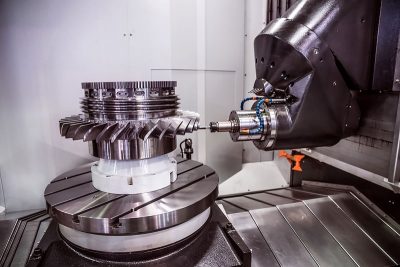
Engineers disagree on this question. Some print gripper fingers in carbon-filled polymers for speed and low cost. Others machine every gripper from aluminium and never look back.
Both methods have a place. Printing suits early prototypes and complex, lightweight vacuum parts. Machining suits parts that must resist wear, hold threads, stay stiff and keep precise locating features over years of continuous running.
Wear sets a practical limit on polymer, particularly when grippers handle abrasive, hard or threaded parts. Printed threads and contact faces can wear quickly, and a worn finger quietly shifts where the robot places each part.
The case for printing often rests on lead time. A machined gripper from a slow supply chain can take weeks, while a printed one can arrive in days. With a fast machining partner, that difference largely disappears. A production-grade metal part can arrive within days, or within hours for urgent work.
Many teams now combine the two. They print a gripper to prove its geometry on the line, then machine the final design for production.
The Real Cost of a Stopped Line
A worn gripper jaw or cracked bracket costs little to replace. The stoppage it causes costs far more. On a busy line, an hour of lost output can easily cost more than every machined part in the cell combined.
Three habits reduce this risk:
- Hold machined spares for known wear parts, such as gripper fingers and nests.
- Keep CAD models and drawings up to date for every custom part in the cell.
- Agree an emergency route with your machining supplier before you need it.
Thompson Precision’s fast CNC turnaround department produces time-critical components in as little as 12 hours, with a quotation target of two to three hours. Where original drawings no longer exist, a worn part can be reverse engineered and remade.
Smaller Manufacturers Are Automating, One Cell at a Time
Automation is no longer limited to large car plants. Small and medium manufacturers are adding their first robot cells for machine tending, packing, palletising and inspection, and government support for this type of investment is growing.
These first-time projects bring different demands. They usually need small batches of custom parts, often at short notice, and designs can change during commissioning. A supplier set up for long production runs may struggle to respond.
Low and medium volume CNC machining suits this work well. Our article on machine shop automation explains how automation is changing precision machining itself.
What to Look For in a Machining Partner
Not every machine shop suits automation work. Look for:
- Certified quality systems. Thompson Precision has held ISO 9001 certification since 1990.
- A large machining envelope. Ours handles parts up to 2m x 1m x 0.6m, which covers most frames and base plates.
- 5-axis capability. This produces complex manifolds and tooling in fewer set-ups.
- Design support. Engineers who can suggest changes that improve stiffness, reduce weight or lower cost.
- Clear ownership. At Thompson Precision, one engineer takes each job from start to finish, so you deal with the person who knows your part.
- Finishing under one roof. Sourcing, machining, painting, plating and polishing managed together.
Precision at Every Interface, From First Cell to Full Line
A robot’s published repeatability means little if the parts around it are inaccurate. Base plates, fixtures, frames and tooling set the accuracy of the whole cell, and they decide how quickly the line can restart after a failure.
To summarise the main points:
- Machined datums keep the mounting chain accurate.
- Materials should suit each job, with low weight at the end of the arm.
- Printing suits prototypes, while machining suits wear-critical production parts.
- Spares and fast supply protect against expensive downtime.
Thompson Precision has supplied precision parts since 1939 and brings that experience to CNC machining for automation and robotics. We work with integrators, OEMs and production teams on demanding, high-tolerance work. To discuss a cell or an urgent replacement, contact our engineers or call 01277 365500.
Frequently Asked Questions
What CNC machined parts does a robot cell need?
Most cells need base plates, end-of-arm tooling, workholding fixtures, frames and sensor brackets. Each part holds the robot and product in a fixed position relative to each other.
Should gripper fingers be machined or 3D printed?
Print fingers to prove the geometry, then machine the production version where wear, stiffness or thread strength matter.
Which materials suit end-of-arm tooling?
Aluminium suits stiff, lightweight tooling. Engineering plastics suit pads and nests that must not mark finished parts.
How quickly can a replacement part be made?
Thompson Precision’s fast turnaround service can produce time-critical parts in as little as 12 hours.
Can you machine from our own CAD files?
Yes. We machine directly from 3D CAD data, and our mechanical design team can help refine a part before it is made.