
Inside an ultra-high vacuum chamber, a gas molecule can travel more than 40 kilometres before it hits another one. That is the scale of emptiness researchers need to study atoms, guide particle beams or grow perfect semiconductor films. It is also the reason a fingerprint the size of a full stop, or a bubble of coolant trapped in a bolt hole, can waste a week of beamtime.
UHV CNC machining is what makes that level of emptiness possible. It is a specialist branch of precision engineering where tolerance is only one part of the job. Cleanliness, material choice, surface finish and design detail matter just as much. This article looks at what UHV work actually involves, which UK sectors are driving demand, and what buyers should look for when sourcing components for particle physics, semiconductor and quantum research.
What UHV Actually Means for a Machined Part
Ultra-high vacuum is a pressure regime below roughly 10⁻⁷ pascal, or about 10⁻⁹ millibar. Extreme high vacuum sits below 10⁻¹⁰ pascal. At those pressures almost no gas molecules remain, which is exactly what beamlines, electron microscopes and semiconductor process chambers need.
For a machinist, UHV changes the brief. A part can be dimensionally perfect and still fail in service. The reason is outgassing. Every material slowly releases trapped gas from its surface and from tiny pockets inside it. In normal engineering that gas is invisible. In UHV it can be enough to raise chamber pressure by orders of magnitude and ruin an experiment.
UHV CNC machining therefore has its own design language, its own approved materials list, and its own cleanliness chain from machine to chamber.
The Sectors Driving UHV Demand in the UK
Particle physics and national research facilities
The UK has world-class research facilities that rely heavily on UHV. Diamond Light Source at Harwell operates 32 beamlines and is currently rolling out its Diamond-II upgrade, which brings new instruments, optics and sample environments. Its neighbours on the same campus, the ISIS Neutron and Muon Source and the Central Laser Facility, share similar vacuum requirements. Every beamline needs chambers, flanges, sample stages and mounting hardware that meet UHV standards.
Semiconductor equipment and cleanroom hardware
The UK government’s £1 billion National Semiconductor Strategy is pulling demand through the supply chain. The Department for Science, Innovation and Technology’s Semiconductor Sector Study 2026 reports that 83% of surveyed firms expect growth over the next three years. Wafer handling equipment, process chambers, load locks and gas delivery systems all need vacuum-compatible parts, and the most advanced lithography systems contain around 250,000 machined components.
Emerging quantum and cold-atom work
Quantum computing and cold-atom sensing add another layer of demand. These experiments trap single ions or atoms in vacuum, and any residual gas particle can knock the trapped particle loose. That has made UHV a foundational requirement for a fast-growing area of British research.
Design Rules That Separate UHV from Standard Precision Work
Standard precision parts and UHV parts look similar on a drawing but obey different rules. Getting these details right is where UHV CNC machining earns its name.
- No blind tapped holes. Blind holes trap air, coolant and cleaning fluid, creating virtual leaks that mimic real ones. Screw holes should be drilled through or vented.
- Radiused internal corners. Sharp corners hold contamination and are hard to clean.
- Vented fasteners. Bolts that seal off pockets of air behind them cause slow leaks over days or weeks.
- Fine surface finish on vacuum-wetted surfaces. A typical target is Ra 0.4 μm or better. Gas-wetted surfaces often need to reach Ra 0.2 μm through electropolishing.
- Correct materials. Common choices include 316L stainless steel, 6061 aluminium, titanium, OFHC copper and engineering plastics like PEEK and PTFE. All have low vapour pressure and low outgassing.
- Metal seals where possible. Elastomer seals outgas more than metal ones and are avoided in the cleanest UHV zones.
These rules cut across most complex CNC machining work, but for UHV they are non-negotiable.
The Cleanliness Chain from Machine to Chamber
Cleanliness is where UHV projects most often go wrong at the supplier stage. It is not a step at the end. It is a discipline that runs from the machine tool onwards.
Standard shop coolants are usually forbidden. They leave hydrocarbon residues that will vent slowly inside a chamber for months. Some UHV parts are cut dry, others with specially approved coolants and aspirated chip extraction. Silicon-based greases and sealants are also banned, because silicon contamination can wreck sensitive surface science and semiconductor processes.
Post-machining, parts follow a strict sequence. Ultrasonic cleaning removes fine particles and residues. A deionised water rinse follows. Inspection happens in a temperature-controlled environment on a CMM, because thermal expansion can shift readings on parts held to microns. Finished components are then sealed in cleanroom-compatible bags, often multiple layers, to protect them in transit.
Verification is the final gate. Assemblies are typically helium leak tested to around 10⁻⁹ atm-cc/sec. Some semiconductor customers also ask for residual gas analysis to confirm outgassing behaviour.
Common Mistakes in Sourcing UHV Components
Even experienced engineering buyers can trip up on UHV work. A few patterns come up again and again.
The first is treating UHV as tight-tolerance CNC with extra polishing. It is not. A part with excellent tolerances but a trapped coolant pocket in a blind hole will fail on the first pump-down.
The second is specifying materials without checking vapour pressure and outgassing data. Not every stainless is created equal, and not every aluminium alloy behaves the same in vacuum.
The third is leaving cleaning specifications off drawings. Suppliers cannot deliver clean parts if the cleanliness standard is not written down. Silence usually means shop-standard, which is not UHV.
The fourth is choosing a supplier without a temperature-controlled inspection room and a large-capacity CMM. Precision measurement of vacuum hardware often demands both.
The final one is discovering during commissioning that a part is fine dimensionally but has a virtual leak. By then the schedule slip is already baked in.
What to Look For in a UHV Machining Partner
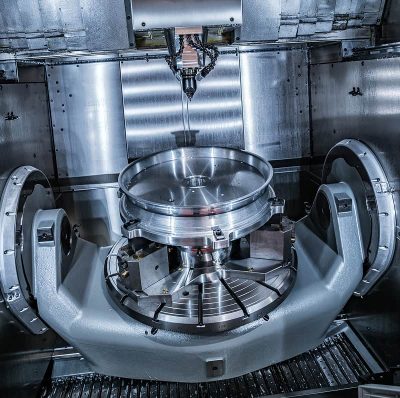
A capable UHV CNC machining partner brings four things to the table. Multi-axis capability, so complex chambers can be produced from solid billet with as few setups as possible. Deep familiarity with the materials involved, from stainless and titanium to engineering plastics. In-house, temperature-controlled inspection with automated CMM reporting. And documented cleaning procedures that can either follow a house standard or adopt a customer’s own protocol.
Thompson Precision has served scientific sector work for decades, machining UHV chambers, heater plates, sample stages and precision fixtures for flight instruments, mass spectroscopy, electron microscopy, coating and medical applications. Our shop runs 3, 4 and 5 axis machining centres, our inspection department is temperature-controlled, and our team is comfortable adopting customer-specific cleaning and packaging instructions.
The same principles that separate a specialist supplier in this field are the ones we cover more broadly in our piece on what makes a quality precision engineering company. UHV is where those principles are tested most severely.
Where UHV CNC Machining Sits in the UK’s Research Ambitions
The UK’s future in advanced research, quantum computing and compound semiconductor manufacturing depends on a steady flow of specialist hardware. Diamond-II, the National Semiconductor Strategy and the growing quantum programme all point in the same direction: more UHV components, tighter timelines and less margin for error.
The suppliers who can deliver those parts, first time, will be the ones with the right machines, the right materials knowledge and the right cleanliness discipline. If you are sourcing UHV components for a beamline, a wafer tool, a cryostat or a research prototype, talk to our team and we can walk through the design and cleanliness requirements before you commit to a drawing.
Answers to the Most Common UHV Machining Questions
What pressure counts as ultra-high vacuum?
UHV is generally defined as pressures below 10⁻⁷ pascal, or about 10⁻⁹ millibar. Anything below 10⁻¹⁰ pascal is classed as extreme high vacuum.
Can aluminium be used for UHV parts, or is stainless steel always required?
Yes, aluminium is widely used, especially 6061. It has low vapour pressure and machines well. Stainless 316L is chosen when strength, corrosion resistance or bakeout temperature demand it.
Why can’t standard CNC coolant be used on UHV parts?
Standard coolants leave hydrocarbon residues that outgas inside vacuum chambers for months. UHV parts are cut dry or with specially approved coolants, then cleaned to remove any trace.
How is UHV cleanliness verified before parts leave the shop?
Parts are ultrasonically cleaned, rinsed in deionised water, inspected in a temperature-controlled room and sealed in cleanroom-compatible packaging. Assemblies are commonly helium leak tested to around 10⁻⁹ atm-cc/sec.
What lead times are realistic for UHV components?
Lead times vary with material availability, complexity and cleaning requirements. Simple parts can be produced in days, larger chambers typically take several weeks. Planning cleaning and inspection into the schedule from the start avoids most delays.