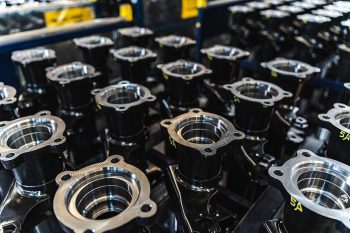
A structural aerospace component can start its life as a billet of aluminium weighing more than a tonne and finish as a finely machined part weighing under a hundred kilos. The rest leaves the machine as a mountain of chips.
At first glance, that looks wasteful. In reality, it is how some of the most demanding airframes in the world are built. The method is called solid billet CNC machining, and for primary structural parts on modern aircraft, it remains the default choice.
This article explains why. It covers the engineering logic behind machining from solid, the materials that dominate the work, the technical challenges of removing 90 percent of a block of metal without ruining the part, and how this approach compares with forging and additive manufacturing. It also looks at what separates a shop capable of certified aerospace structural work from a general 5-axis machinist.
If you specify, procure, or design structural aerospace parts, this is the context behind the decisions you are making every day.
What Solid Billet Machining Actually Means in Aerospace
Solid billet CNC machining for aerospace is a subtractive process. A single block of certified wrought metal is held in a CNC machine, and material is removed until the finished part remains. There are no welds, no fasteners, and no joins. Engineers call this a monolithic structure, and shop floors often call it “hog-out” machining because so much material is taken away.
It is the opposite of an assembled structure, where smaller forgings, castings, sheet metal pressings, or extrusions are bolted, riveted, or bonded together to form a finished component.
Monolithic machining is not a niche method. Airbus holds a patent covering the manufacture of wing ribs machined from a single solid billet, in which the web and flanged portions are formed as one monolithic structure. That patent reflects how mainstream this approach has become for primary structure.
Why Aerospace Engineers Choose Solid Billet for Structural Parts
There are four reasons solid billet machining keeps winning the design argument for structural work.
Strength Without Joints
Every joint in an assembled structure is a potential weak point. Fasteners create stress concentrations. Welds introduce a heat-affected zone with different properties to the parent material. Bonded joints depend on surface preparation that is hard to inspect.
A monolithic part has none of these. The load path runs through a single, continuous piece of metal. Fatigue performance is more predictable, and inspection is simpler because there are fewer interfaces to worry about.
Predictable Material Properties
Wrought aerospace billet is heavily characterised. Alloys such as 7050-T7451 aluminium and Ti-6Al-4V titanium come with certified mechanical properties, batch traceability, and decades of test data behind them. For primary structure, where failure is not an option, that predictability matters more than almost anything else.
Geometric Freedom
Five-axis machining lets engineers integrate features that would be impossible or expensive to assemble. Pockets, undercuts, bosses, lugs, and mounting features can all live in the same part. This reduces part count, cuts assembly time, and almost always reduces overall weight.
Traceability and Certification
A part from solid billet has one material certificate, one heat treatment record, and one set of inspection results. That clean documentation chain is exactly what aerospace quality systems are built around. Shops working in this space typically operate to ISO 9001 or AS9100. Thompson Precision has held ISO 9001 certification since 1990 and supports aerospace CNC machining with full traceability and First Article Inspection Reports.
The Materials That Dominate Structural Billet Machining
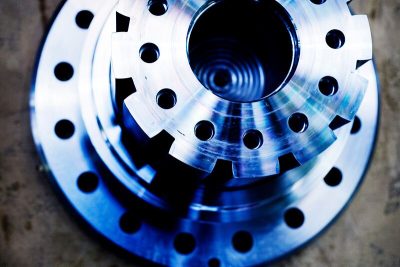 Material choice drives almost every downstream decision in solid billet CNC machining for aerospace. A handful of alloys do most of the heavy lifting.
- 7050-T7451 aluminium plate. The workhorse for wing ribs, spars, and bulkheads. The T7451 temper is stress-relieved through stretching, which makes it dimensionally stable when large amounts of material are removed. It also offers excellent fracture toughness and resistance to stress corrosion cracking.
- 7075-T7351 aluminium. Very high strength, but more sensitive to distortion in thick sections.
- Ti-6Al-4V titanium. Used where strength-to-weight, fatigue resistance, or temperature demands push beyond aluminium. According to industry sources, titanium now accounts for roughly 15 percent of the structure of modern aircraft.
- Specialty alloys. Inconel and high-strength stainless grades appear in engine-adjacent structural fittings, landing gear components, and high-temperature applications.
Choosing the right alloy is upstream of every other engineering decision. Get it wrong, and the best machining strategy in the world will not save the part.
The Engineering Reality of 90 Percent Material Removal
This is where solid billet machining gets honest about its trade-offs.
The Buy-to-Fly Ratio
Buy-to-fly is the industry’s term for the ratio of raw material purchased to material that actually flies on the aircraft. An estimated 6 pounds of mill material is required for every 1 pound of final material used on the aircraft, giving an industry-wide average around 6:1. For titanium, the figures are higher. The buy-to-fly ratio for titanium is typically between 10 and 16, meaning a raw input of 10 kg of titanium ends up as a finished part weighing 1 kg.
Those numbers look alarming on a sustainability report. The honest answer is that aluminium chip is recycled at very high rates, and the alternatives often carry hidden costs in weight, assembly labour, and inspection burden. The industry is moving toward near-net-shape forgings and additive preforms to bring those ratios down, but for primary structure, certified wrought billet still dominates.
Managing Residual Stress and Distortion
When you remove material from a billet, locked-in stresses from the rolling or forging process release. The part bows, twists, or warps. This is the single hardest problem in structural billet machining.
The numbers are sobering. In the fabrication of aerospace frames and beams, stress-relief-induced deformations often increase non-conformance rates and require costly corrective processes, with thin-walled beam structures typically showing flatness deviations of 0.1 to 0.5 mm after machining. Industry studies suggest that around 40 percent of failure cases in aerospace aluminium components are linked to machining-induced residual stress.
Experienced shops manage this through a combination of stress-relieved material, symmetrical roughing strategies, intermediate stress relief steps, and careful fixturing that does not clamp distortion into the part.
Thin-Wall Machining and Workholding
Aerospace structural parts routinely feature walls of 1 mm or less, with high aspect ratios. Holding a 600 mm long wing rib with 1.2 mm walls in a way that resists chatter, allows tool access, and does not flex under cutting forces is genuinely difficult.
The solutions involve vacuum fixturing, sacrificial soft jaws, dedicated holding fixtures machined for one part family, and the discipline to support the part as it gets thinner with each pass.
The Machines and Strategies Behind the Process
Solid billet CNC machining for aerospace lives or dies on three things: the machine, the toolpath, and the inspection regime.
Five-axis simultaneous machining is fundamental. It allows complex pocketing, undercut access, and integrated features to be cut in fewer setups, which protects accuracy because every re-fixturing introduces error. Large 5-axis CNC machining capability is what separates shops that can handle structural aerospace work from those that cannot.
Modern toolpath strategies matter just as much. Trochoidal milling and high-efficiency milling keep tool engagement constant, which means higher feed rates, better tool life, and faster cycle times. For aluminium, material removal rates above 8,000 cm³/min are achievable with the right combination of machine, tooling, and CAM strategy.
Inspection closes the loop. In-process probing compensates for stock variation. Final inspection on a temperature-controlled CMM verifies that the finished part meets specification. Thompson Precision’s inspection envelope covers components up to 1600 by 900 by 800 mm, supported by high precision CNC machining processes operating to ISO 9001.
Where Solid Billet Machining Sits Against Forging and Additive
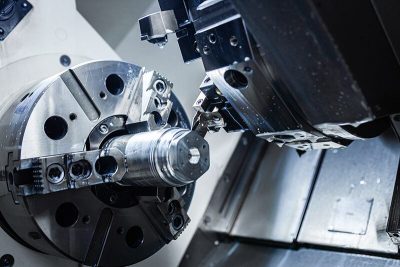 Solid billet CNC machining for aerospace is not the only option, and a balanced view matters.
Near-net-shape forgings reduce buy-to-fly significantly but limit geometric freedom and add lead time. They suit high-volume parts where tooling amortisation makes sense.
Additive manufacturing is the headline-grabbing alternative. Airbus has been developing wire-Directed Energy Deposition, a 3D printing technique that uses a multi-axis robotic arm with a spool of titanium wire to create structural aircraft parts with less material waste than traditional machining from plate or forging. For structural titanium components such as the emergency exit frame on an Airbus A350, Wire Arc Additive Manufacturing can deliver material savings of over 95 percent compared to conventional machining.
For primary structure today, certified wrought billet remains the default. Additive complements rather than replaces solid billet machining for the foreseeable future, particularly while certification processes for aerospace AM parts continue to mature.
Real-World Examples of Structural Billet Machining
The applications are everywhere on a modern aircraft:
- Wing ribs and spars, machined from 7050-T7451 plate, forming the internal skeleton of commercial and military wings.
- Bulkheads and fuselage frames, often in titanium for military platforms, where strength-to-weight is paramount.
- Pylon and engine mount fittings, machined from titanium billet to handle high fatigue loads.
- Satellite primary structures, machined as single monolithic parts from aluminium to ensure dimensional stability and vacuum compatibility.
- Aerospace test fixtures and assembly jigs, where rigidity and accuracy depend on machining from solid rather than fabrication.
Thompson Precision regularly produces parts and assemblies across these categories, with particular strength in aerospace special fasteners and test fixtures.
Choosing a UK Partner for Structural Billet Machining
Not every CNC shop can handle structural aerospace work. The differentiators are practical:
- Quality certification. ISO 9001 as a minimum, AS9100 for primary structural work with major OEMs.
- Large-envelope 5-axis capability. Without it, geometric complexity becomes a constraint rather than a benefit.
- In-house inspection. Temperature-controlled CMM, probing, and First Article Inspection Reports as standard.
- Engineering input. The ability to advise on design for manufacture, material selection, and fixturing strategy before a chip is cut.
- Material discipline. Holding aerospace grades in stock, with full traceability and certification.
Thompson Precision has been making precision components since 1939, operates from a facility in Essex with over 20 CNC machines, and combines solid billet CNC machining with full mechanical design and inspection capability under one roof.
Why Solid Billet Still Defines Modern Aerospace Structures
Solid billet CNC machining for aerospace is not a legacy method waiting to be replaced. It is the certified, predictable, and geometrically flexible way that the most demanding parts of an aircraft are built today. The buy-to-fly numbers look high in isolation, but the engineering trade-offs continue to favour monolithic structure for primary load paths.
Additive manufacturing and near-net-shape forging will reshape parts of this landscape over the next decade. They are not, however, the default for structural primary parts in 2026, and they will not be for some time. The fundamental advantage of starting with certified wrought material and machining away everything that is not the part remains intact.
What separates aerospace-capable shops from generalists is not the machine on the floor. It is the engineering judgement to manage residual stress, the discipline to hold tolerance through long cycles, and the traceability to prove every step. If you are specifying structural aerospace parts for production in the UK, those are the qualities worth looking for. To discuss a current project, contact Thompson Precision directly.