
Choosing the right manufacturing process for a plastic component is not always straightforward. Many engineers default to injection moulding because that is how the final part will eventually be made, then discover that tooling costs and lead times make no sense for a prototype or a small production run.
Plastic CNC machining solves this problem. Instead of building a mould, the part is cut directly from a solid block or rod of plastic using milling machines and lathes. For medical and electronics buyers, where designs often change during development and volumes may never justify a mould, this approach can save weeks and thousands of pounds.
This guide explains how plastic CNC machining works, why it suits medical and electronics applications so well, which plastics to consider, and the mistakes worth avoiding.
What plastic CNC machining actually involves
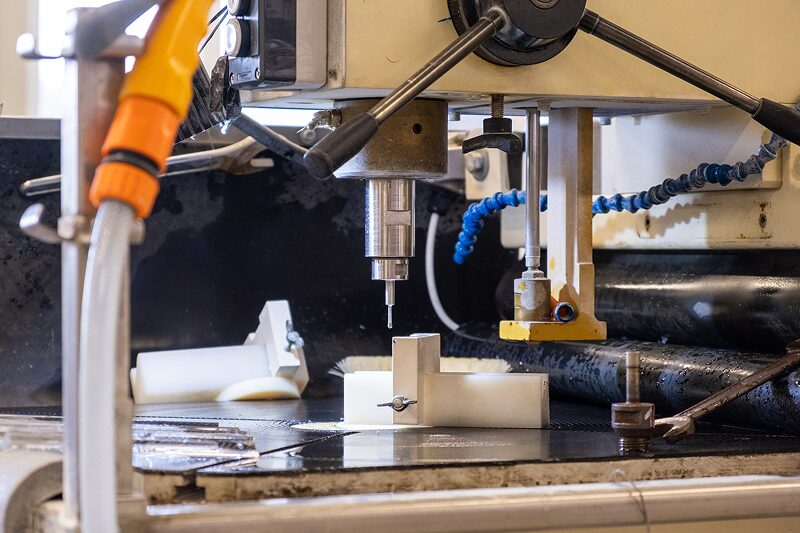
CNC machining is a subtractive process. A block or rod of plastic is loaded into a machine, and a cutting tool removes material until the finished shape emerges. This is different from injection moulding, where molten plastic is forced into a pre-made tool, and different again from 3D printing, where material is built up layer by layer.
Machining suits low and medium volume production particularly well. There is no tooling to design or pay for, so a single part or a batch of fifty can be produced just as easily as a batch of five hundred. If the design changes, the programme is updated and the next part reflects that change immediately.
For plastics specifically, this means designers can test real mechanical, thermal and chemical properties before committing to expensive tooling. A plastic CNC machining specialist can machine complex 3D shapes using both milling and turning, working from a customer drawing, CAD file or even a physical sample.
Why medical and electronics buyers reach for it
Both sectors share a common pressure: designs are often safety-critical, time-critical, or both. Getting from concept to a working prototype quickly, without locking into a fixed design too early, matters more than in many other industries.
Medical sector needs
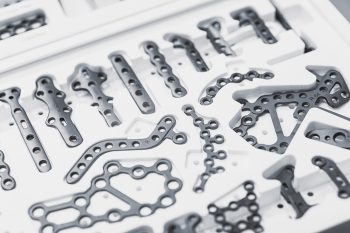
Medical and pharmaceutical projects frequently involve bespoke equipment for research and development, alongside low volume production of specialist devices. Materials need to withstand cleaning and sterilisation, and in some cases must be biocompatible.
PEEK is a strong example. Certain grades are rated for biocompatibility and are used in temporary implants, surgical instruments and fluidic device housings, largely because the material tolerates repeated sterilisation without warping. Other engineering plastics, such as Acetal and PTFE, are chosen for their chemical stability when parts come into contact with reagents or cleaning agents.
Thompson Precision’s work in this area includes machining complex bespoke parts for research and development, as well as precision lenses and plates for the scientific and pharmaceutical industries.
Electronics sector needs
Electronics buyers care about different properties. Electrical insulation, dimensional stability and resistance to heat build-up around components all matter, particularly in enclosures, standoffs and connector parts.
Plastics such as PEEK, PTFE and Nylon are common choices here because they do not conduct electricity and hold their shape reliably under load. Many electronics and computing projects also need bespoke enclosures machined from solid billet, giving stronger, more precise results than off-the-shelf alternatives, particularly for low volume electronics enclosures where a standard part simply will not fit.
Choosing the right plastic for the job
Not every plastic behaves the same way under a cutting tool, and not every plastic suits every application. A few examples worth knowing:
- Acrylic and polycarbonate: good for enclosures, covers and optically clear components, though acrylic needs polishing after machining to restore clarity
- PEEK: heat resistant, chemically stable, and available in biocompatible grades for medical use
- PTFE: excellent chemical resistance and electrical insulation, though soft and prone to distortion if machined without care
- Acetal (Delrin): machines cleanly, strong and stable, a common choice for precision mechanical parts
- Ultem and PET: useful where strength and dimensional stability under stress are priorities
A precision machining partner should be able to source standard and non-standard grades and sizes of these materials, and offer engineering input on which one actually fits your application rather than simply machining whatever is specified on the drawing.
Common mistakes buyers make
A few mistakes come up repeatedly when buyers approach plastic CNC machining for the first time.
- Assuming all plastics machines are the same way. Acetal cuts cleanly, while soft materials like PTFE need different tooling and technique to avoid distortion.
- Believing 3D printing is always the faster or cheaper option. It often is for very early concept models, but for a functional prototype that needs accurate fit and real material behaviour, machining frequently saves time overall by avoiding rework.
- Forgetting that some finishes are a separate step. Machined acrylic will look frosted rather than clear until it has been polished.
- Assuming any PEEK is safe for medical contact. Biocompatible grades are specific, and this should always be confirmed directly with your supplier before use.
What good precision plastic machining looks like
The difference between an adequate supplier and a genuinely good one usually comes down to three things: accuracy, engineering input, and turnaround.
Accuracy should be backed by proper inspection, ideally using a CMM-equipped inspection department to confirm every component matches the customer’s data, with test-fitting against other parts where required. Engineering input matters just as much. A good partner will flag a design problem before it becomes a wasted machining run, not after.
Turnaround is often the deciding factor for time-critical projects. A supplier offering a genuine fast CNC turnaround service, without cutting corners on tolerance or finish, gives medical and electronics buyers the flexibility to iterate on a design without losing weeks each time.
Getting the material and the manufacturing process right at the outset avoids costly rework further down the line. If you are working on a medical or electronics project that needs bespoke plastic components, it is worth getting in touch early, while the design is still open to input.
FAQ
Can plastic parts match the tolerances of machined metal?
Yes. With the right machines and inspection process, plastic components can be held to tight, repeatable tolerances comparable to many metal parts.
Is CNC machined plastic suitable for medical implants?
Some grades, particularly certain PEEK variants, are biocompatible and used in temporary implants and surgical instruments. This must always be confirmed with your supplier before use.
How does cost compare with injection moulding?
Machining avoids tooling costs entirely, making it far more economical for prototypes and low volumes. Moulding becomes more cost effective once volumes are high and the design is finalised.
What plastics are best for electronics enclosures?
PEEK, PTFE, Nylon and polycarbonate are common choices, depending on whether insulation, heat resistance or durability is the priority.
Can acrylic parts be made optically clear after machining?
Yes. Machined acrylic typically has a frosted appearance straight off the machine and needs polishing afterwards to restore optical clarity.