There are more precision engineering companies to choose from than ever. That sounds like good news for buyers, but the reality is more complicated.
The UK precision engineering market is splitting in two. Specialist, well-invested companies are seeing strong demand. Generalist, lower-margin operations are under real pressure. The gap between the best and the rest is widening, and for buyers sourcing components for safety-critical or time-critical programmes, the cost of picking the wrong partner is significant.
This article is a practical guide for procurement engineers, project leads, and technical buyers who need to make that call with confidence. The seven markers below are grounded in how the sector actually works in 2026, not how suppliers describe themselves on their websites.
Why 2026 Is a Meaningful Moment to Reassess Your Supplier Criteria
Three forces are reshaping what quality looks like in precision engineering right now.
The first is reshoring. After years of supply chain disruption, more original equipment manufacturers (OEMs) are bringing production closer to home. UK precision subcontractors with strong accreditations and proven capability are seeing the benefit of that shift.
The second is surging demand across aerospace and defence. UK defence spending is set to rise to 2.6% of GDP by 2027, with a longer-term target of 5% by 2035. Commercial aircraft orders hit their highest Q1 total since 2013 earlier this year. Both trends are feeding directly into demand for precision-machined components.
The third is a skills shortage that is making experienced teams harder to find. According to Make UK, 36% of manufacturing vacancies are difficult to fill because candidates lack the right skills. That figure is significantly higher than the 24% average across all UK industries. A machining company with a skilled, stable team is worth more than it was five years ago.
Against that backdrop, here is how to tell a genuine precision engineering company from one that simply looks the part.
Marker 1: Certification That Reflects the Standard of the Work
Quality certification is not just a badge. It is evidence that a company runs documented processes, submits to regular third-party audits, and has formal systems for catching and correcting errors.
ISO 9001 is the internationally recognised quality management standard that applies across industries. It covers how a company plans, monitors, and improves its processes to deliver consistent quality. For many applications, it represents the minimum acceptable threshold.
For aerospace and defence work, buyers should also be aware of AS9100, the aerospace-specific extension of ISO 9001. It adds requirements around risk management, product safety, configuration control, and counterfeit part prevention. Over 80% of global aerospace companies require AS9100 certification from their CNC suppliers. If your components go into flight-critical or defence applications, it is worth understanding which standard applies to your programme and checking whether your supplier meets it.
Either way, ask to see the certificate scope, not just a logo on a website. A certificate with a narrow scope that does not cover the work you are placing is not the assurance it appears to be.
Marker 2: Genuine Capability for Complex Geometry
The difference between a machining company that can take on complex work and one that cannot often comes down to axis capability.
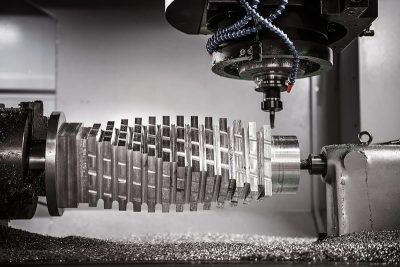
A standard 3-axis CNC machine moves a cutting tool in three directions: left and right, forward and back, and up and down. That covers a wide range of parts. But components with angled features, curved surfaces, or features on multiple faces require more axes of movement. A 5-axis machine can tilt and rotate the part or the tool continuously, reaching geometry that would require multiple setups on a 3-axis machine.
More setups mean more opportunities for error to accumulate. Reducing them improves positional accuracy and surface finish, which matters enormously on tight-tolerance work.
Thompson Precision’s large 5-axis CNC machining capability handles parts up to 2 metres x 1 metre x 0.6 metres, covering structural components and large enclosures that most shops cannot accommodate.
Equipment and Expertise Are Not the Same Thing
Owning a 5-axis machine is not the same as knowing how to use it well. Fixturing a complex part correctly, writing the toolpaths that avoid collision and maintain accuracy, and then inspecting the output against a demanding drawing requires experience that takes years to develop.
When you are evaluating a precision engineering company, ask to see examples of complex work they have actually delivered, not just a list of the machines on the shop floor.
Marker 3: Material Knowledge That Goes Beyond the Standard List
Most machining companies can work with common materials. Fewer have genuine experience with the alloys and materials that safety-critical industries require.
Aerospace structural components are often machined from high-strength aluminium alloys such as 7050-T7451, or from titanium alloys like Ti-6Al-4V. Both materials machine differently from standard grades and require specific tooling strategies, feed rates, and cooling approaches to maintain dimensional accuracy without inducing stress or distortion in the part.
For scientific research and particle physics applications, components often need to be compatible with ultra-high vacuum environments. That places strict demands not just on dimensional accuracy but on surface finish, material selection, and cleanliness. Thompson Precision’s UHV CNC machining service is a specialist capability that very few precision engineering companies in the UK can offer.
Ask any potential supplier about their experience with your specific material. A company that has machined it many times will respond differently to one that has only done so occasionally.
Marker 4: A Quality System That Works in Practice, Not Just on Paper
A quality management system is only as good as the people running it. There is a real difference between a company that holds a certificate because it keeps tidy paperwork, and one that has embedded quality thinking into every stage of production.
In practice, a well-run quality system means:
- Materials are checked and traceable from the point of receipt
- Dimensions are verified during machining, not just at the end
- Non-conformances are documented and investigated, not quietly set aside
- Inspection reports are provided with the parts as a matter of course
Coordinate measuring machines (CMMs) are the standard inspection tool for precision components. A CMM uses a physical probe to measure a part’s dimensions with very high accuracy, then generates a report showing how those dimensions compare to the drawing. If a supplier cannot offer CMM inspection or provide dimensional reports, that should prompt questions about how they are verifying the work they send out.
Ask a prospective supplier how they handle a non-conformance. How they answer that question tells you a great deal about whether their quality system is real.
Marker 5: Experienced Engineers Who Own the Work
 The UK engineering skills shortage is a genuine constraint on the sector. Around 20% of UK engineers are expected to retire in the coming years, taking decades of practical expertise with them. Only 15% of UK engineers are currently under 30. The pipeline is not keeping pace with the demand.
Against that backdrop, a company with a skilled, stable team is a significant asset to its customers.
But it is not just about having experienced people. It is about how they are deployed. At Thompson Precision, each engineer takes full responsibility for a job from start to finish. That means one person handles the drawing interpretation, the CNC programming, the tooling selection, the machine setup, the production, and the inspection. They are not passing work down a line where no single person holds the full picture.
That model produces better results. When an engineer owns a job entirely, they make better decisions at each stage because they understand where the part has come from and where it needs to go.
When you are evaluating a precision engineering company, ask how long their senior machinists and programmers have been with the business. High turnover is a warning sign. Stability, in this sector, translates directly into consistent output.
Marker 6: Fast Turnaround as a Structural Capability, Not a Sales Line
Almost every machining company claims to offer fast turnaround. Very few have built the operational infrastructure to deliver it reliably, at precision tolerances, without compromising quality.
Genuine fast turnaround requires disciplined scheduling, available machine capacity at short notice, and engineers experienced enough to programme and set up quickly without cutting corners. It is a function of how a business is run, not something that can be switched on when a customer is desperate.
Thompson Precision’s fast CNC turnaround service delivers parts in as little as 12 hours when urgency demands it, with a typical lead time of five days. That is useful for product development teams under pressure, for manufacturers whose own capacity has failed, and for programmes where a delayed component creates a costly knock-on effect.
The question to ask any supplier is not whether they offer fast turnaround, but what that actually means in practice. Ask for examples of recent urgent jobs, and how they managed scheduling and quality alongside the time pressure.
Marker 7: Sector Experience That Reduces Surprises
Machining a component for an aerospace programme is not the same as machining a component for an industrial application, even if the geometry and material are identical.
Aerospace work carries documentation requirements, traceability expectations, and tolerance standards that are not standard in every sector. A company that has served aerospace buyers for many years will understand those requirements and have processes in place to meet them. A company encountering them for the first time will be learning on your programme.
The same is true for medical, scientific, and defence work. Each sector carries specific expectations around documentation, cleanliness, material traceability, and process control. Experience in these areas reduces the risk of costly errors and miscommunication.
Thompson Precision has been producing high-precision components since 1939, serving aerospace, defence, scientific, medical, electronics, marine, and automation sectors. That depth of sector experience means fewer surprises and more confidence that a supplier has genuinely seen the type of work before.
Before You Commit to a Supplier
Once you have assessed a precision engineering company against these markers, a few practical steps are worth taking before placing work.
- Request a facility visit or at least a virtual tour. You will learn more from seeing a shop floor than from reading a brochure.
- Ask for examples or case studies from your sector. Not logos on a website, but actual descriptions of the work completed.
- Submit a sample drawing or enquiry, and pay attention to how they respond. The quality of their technical questions, the clarity of their quotation, and the speed and accuracy of their communication are early signals of how they will behave mid-programme.
- Ask how they handle design queries or drawing ambiguities. A good precision engineering company will flag issues before they machine, not after.
The enquiry stage is a low-risk opportunity to assess a supplier. Use it.
The Standard Has Risen – Choose a Partner Who Has Risen With It
The precision engineering sector in 2026 rewards companies that have invested in the right machinery, in experienced people, in quality systems, and in the depth of sector knowledge that comes from decades of difficult, demanding work.
For buyers, the seven markers above turn a difficult judgement call into a structured evaluation. The aim is not to find the cheapest supplier, or even the fastest. It is to find a precision engineering company that will deliver the right result on work where the consequences of getting it wrong are real.
If you have a project that requires specialist precision machining services and want to talk through what it involves, contact Thompson Precision on 01277 365500 or get in touch by filling out our contact form.