
Precision Bearings & Tolerances
Did you know that a misalignment of just 0.01mm in a robotic arm joint can cut its operational lifespan in half?
In the world of robotics, even the smallest deviation can lead to vibration, increased wear, and costly downtime. When every fraction of a millimetre counts, precision isn’t just a design detail, it’s the foundation of performance.
From assembly line robots to aerospace manipulators, the smoothness, accuracy, and durability of every movement depend on how precisely those joints are engineered. Minute variations in bearing alignment or tolerance control can mean the difference between consistently flawless motion and gradual mechanical failure.
In this article, we’ll break down exactly how precision bearings and tight tolerances transform robotic arm joints from good to exceptional. You’ll learn how to choose, machine, and maintain components that ensure reliability, longevity, and repeatable accuracy… no matter how demanding the application.
Why Precision Matters in Robotics
In robotics, precision is everything.
Whether it’s an industrial manipulator assembling microchips or a surgical robot performing delicate procedures, each joint must move with seamless accuracy. Even the slightest play or imbalance can cause inefficiency, vibration, or long-term wear, issues that high-quality engineering can prevent entirely.
At Thompson Precision, we specialise in CNC machining, aerospace-grade components, and robotic engineering. Backed by decades of precision engineering expertise, we’ve helped clients refine robotic joint assemblies that operate to microns of accuracy. Our work supports industries where perfection isn’t optional, it’s the difference between success and failure.
From industrial automation systems that run around the clock, to aerospace robotics working in extreme environments, to medical devices designed for lifesaving precision, every one of these applications depends on flawless bearing design and exacting tolerance control.
Understanding Robotic Arm Joints
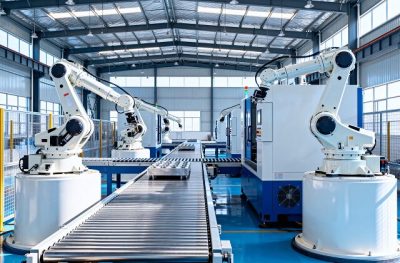
At its core, a robotic arm joint is a mechanical connection that allows controlled movement between two segments of a robot’s structure. Much like the human elbow or wrist, these joints enable the arm to bend, rotate, extend, and position components with pinpoint accuracy. Every movement a robot makes, whether it’s tightening a bolt or lifting an aircraft panel, depends on how each joint translates motion into controlled action.
Robotic systems use a range of joint types, each serving a specific function in motion and articulation:
- Rotational (revolute) – provides motion around a single axis, allowing the arm to rotate or pivot.
- Linear (prismatic) – permits movement along a straight path, ideal for tasks requiring precision positioning or repetitive extension.
- Spherical and universal – combine multiple degrees of freedom for complex, multi-directional movement, often used in advanced or humanoid robotics.
The performance of every joint depends directly on bearing quality and tolerance consistency. Even a perfectly programmed robot can’t achieve smooth or accurate motion if mechanical imprecision exists within the joints. The closer each joint and bearing are machined to their design tolerances, the more precisely the robot can move, transforming theoretical precision into real-world performance.
The Role of Precision Bearings
Precision bearings are the heart of every robotic arm joint. Unlike standard bearings, they’re engineered to maintain exceptionally tight tolerances, ensuring smooth, repeatable motion with minimal friction. In robotics, that accuracy translates directly into reliability, efficiency, and joint longevity.
Key bearing types used in robotic systems include:
- Angular contact ball bearings – ideal for high-speed rotation and combined loads.
- Crossed roller bearings – highly rigid and stable, perfect for articulated movement.
- Thin-section bearings – compact and lightweight, used in space-sensitive designs.
Material choice is crucial, too. Stainless steel resists wear and corrosion, ceramics offer ultra-smooth performance with low thermal expansion, and hybrid bearings balance strength and speed for demanding conditions.
Performance depends on several core features: low friction, even load distribution, vibration resistance, and thermal stability. At Thompson Precision, our ability to machine bearing housings to micron-level accuracy ensures perfect alignment, enhancing smooth motion and extending robotic system life.
Engineering Tolerances Explained
Smooth Movement Starts at the Core
Precision bearings are the heart of every robotic arm joint. Unlike standard bearings, they’re engineered to maintain exceptionally tight tolerances, ensuring smooth, repeatable motion with minimal friction. In robotics, that accuracy translates directly into reliability, efficiency, and joint longevity.
Key bearing types used in robotic systems include:
- Angular contact ball bearings: ideal for high-speed rotation and combined loads.
- Crossed roller bearings: highly rigid and stable, perfect for articulated movement.
- Thin-section bearings: compact and lightweight, used in space-sensitive designs.
Material choice is crucial, too. Stainless steel resists wear and corrosion, ceramics offer ultra-smooth performance with low thermal expansion, and hybrid bearings balance strength and speed for demanding conditions.
Performance depends on several core features: low friction, even load distribution, vibration resistance, and thermal stability. At Thompson Precision, our ability to machine bearing housings to micron-level accuracy ensures perfect alignment, enhancing smooth motion and extending robotic system life.
Aligning Bearings and Tolerances to Design Requirements
Matching Performance Goals with Practical Engineering
Designing robotic joints that perform flawlessly starts with aligning bearing selection and tolerance design to real-world operating demands. Precision engineering is not just about the tightest measurements, it’s about applying them where they matter most.
Here’s a step-by-step approach to achieving that balance:
- Define operational loads and cycles – Understand how much stress, torque, and repetition the joint will face throughout its service life.
- Select bearing type – Choose based on required speed, load direction, and environment (e.g. cleanroom, vacuum, or industrial).
- Determine tolerance stack-ups – Calculate how dimensional variations across components accumulate to maintain perfect alignment.
- Simulate motion – Use CAD and FEA tools to analyse stress, deformation, and movement accuracy before production.
- Validate with prototypes – Confirm fit, smoothness, and reliability under real working conditions before scaling up.
Tight tolerances can drastically improve accuracy and lifespan, but they also raise machining complexity and inspection time. In aerospace robotics, for instance, sub-micron fits are essential due to extreme load requirements, while in factory automation, a slightly looser tolerance can offer faster manufacturing without sacrificing performance.
At Thompson Precision, we achieve this balance through advanced CNC machining, continuous inspection, and strict process control. Our engineers maintain sub-micron accuracy across production runs, ensuring every robotic joint assembly delivers repeatable precision, no matter how demanding the application.
Common Challenges and How to Overcome Them
Even the most carefully designed robotic joints can face performance issues over time. Common challenges include bearing misalignment, which causes uneven wear; excessive backlash, leading to loss of positional accuracy; thermal expansion, which can alter fits under temperature changes; and material fatigue, especially in high-cycle or high-load applications.
To counter these problems, engineers must combine smart design with proactive maintenance. Regular calibration keeps motion systems within specification, while strategic material pairing, such as steel-on-ceramic, reduces friction and extends service life. Controlled lubrication systems help maintain smooth operation, preventing micro-slip that leads to wear. Finally, the use of precision-ground surfaces ensures exact alignment and stability across repeated movement cycles.
At Thompson Precision, we see the results of precision done right. In our assembly work for pick-and-place robotics, maintaining tolerances below ±5 microns prevents vibration and positional drift during high-speed operations. The outcome is consistent accuracy, minimal wear, and long-lasting performance, even under the most demanding conditions.
Measuring and Maintaining Precision
True precision doesn’t end with machining… it’s verified through meticulous measurement and quality control. At every stage of production, accurate inspection ensures that each component meets or exceeds design specifications and performs reliably in the field.
Modern inspection tools make this possible:
- CMM (Coordinate Measuring Machines) capture exact 3D measurements, verifying dimensional accuracy down to microns.
- Laser scanners provide fast, non-contact inspection of complex geometries, ideal for intricate robotic joint assemblies.
- Surface profilometers measure surface texture and flatness to guarantee smooth, low-friction interfaces between moving parts.
At Thompson Precision, our quality assurance process begins with thorough design review, continues through in-process inspection, and concludes with comprehensive in-house testing. This closed-loop approach ensures consistency and confidence from prototype to full production.
Maintaining precision also relies on good metrology practices, proper equipment calibration, controlled temperature environments, and regular verification against certified standards. And once robotic systems are operational, preventive maintenance and periodic re-calibration keep tolerance accuracy intact, extending service life and reducing downtime across high-volume manufacturing environments.
The Future of Robotic Joint Engineering
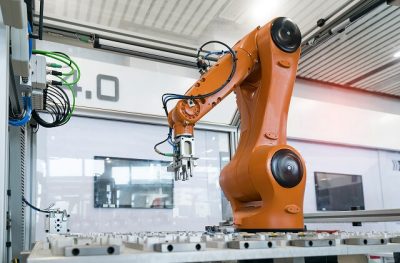
As robotics continues to evolve, the way we design and build robotic joints is changing rapidly. Emerging technologies are pushing the boundaries of precision, intelligence, and durability, redefining what’s possible in automated systems.
One major trend is AI-driven predictive maintenance, where sensors monitor joint load, temperature, and vibration in real time to anticipate wear before it becomes a problem. This data-driven approach minimises downtime and extends operational life, keeping robots productive around the clock.
Materials are also advancing. Self-lubricating composites and hybrid bearing materials offer smoother movement and reduced maintenance, making them ideal for high-speed or isolated environments like space or cleanrooms. Meanwhile, the integration of embedded sensors within bearings and housings allows robots to track load and strain dynamically, enabling smarter, adaptive motion control.
With digital manufacturing and automation improving year after year, tolerances will only tighten further. Sub-micron precision, once confined to aerospace, is becoming standard in next-generation robotics.
At Thompson Precision, we’re at the forefront of this shift, supplying high-accuracy components and precision-machined assemblies for the latest robotic technologies. By combining traditional craftsmanship with advanced metrology and CNC innovation, we help engineers design the intelligent, efficient robots that will drive the future of automation.
Robotic performance begins and ends with precision
High-quality bearings and tight tolerances define how accurately and reliably an arm can move, whether it’s assembling aircraft components or handling delicate instruments. Every micron matters.
Using advanced materials and meticulous machining, engineers can dramatically extend component life and eliminate wear-related issues. Combined with professional inspection, validation, and ongoing calibration, this attention to detail ensures every robotic joint performs exactly as intended, day after day.
If your next robotic project demands accuracy, longevity, and precision beyond the ordinary, Thompson Precision’s expert engineers are ready to help you achieve it. Our team designs and manufactures robotic components to aerospace-grade standards, turning complex motion requirements into mechanical perfection.
Request a Quote or Schedule a Consultation today, and discover how Thompson Precision can take your automation project to the next level of performance.
FAQs
Quick Answers to Common Questions
Why are tolerances so critical in robotic arm design?
Tight tolerances ensure repeatable accuracy, reduce component wear, and improve load handling, essential for precise, consistent robotic movement.
Which bearing types work best for lightweight robotic designs?
Thin-section or crossed roller bearings are ideal for compact, high-precision assemblies where performance and weight reduction are both priorities.
Can Thompson Precision help with prototyping?
Yes, we provide bespoke CNC machining, precision assemblies, and full prototype testing support to help refine your designs before large-scale production.
How do you balance cost and precision?
By carefully assessing each component’s operational function, we apply strict tolerances only where they directly influence performance, ensuring efficiency without unnecessary expense.